


How to Stop Worrying About Everything
Constant worrying can make your mind feel exhausted all day long. Even small problems may start feeling overwhelming when your brain becomes trapped in repetitive anxious thinking.
You may find yourself worrying about:
- the future
- work
- relationships
- health
- money
- conversations
- things that haven’t even happened yet
Over time, constant worrying keeps your nervous system stressed and mentally overloaded.
In this article, you’ll learn how to stop worrying about everything and calm anxious thinking using practical daily techniques.
🧠 Why Do People Worry Constantly?
Worrying is your brain’s attempt to predict and prevent problems before they happen.
Simple explanation:
Your mind believes constant thinking will help you stay safe, prepared, or in control.
However, excessive worrying usually increases stress instead of solving problems.
External reference:
https://www.apa.org/topics/anxiety
🔥 Common Reasons You Worry About Everything
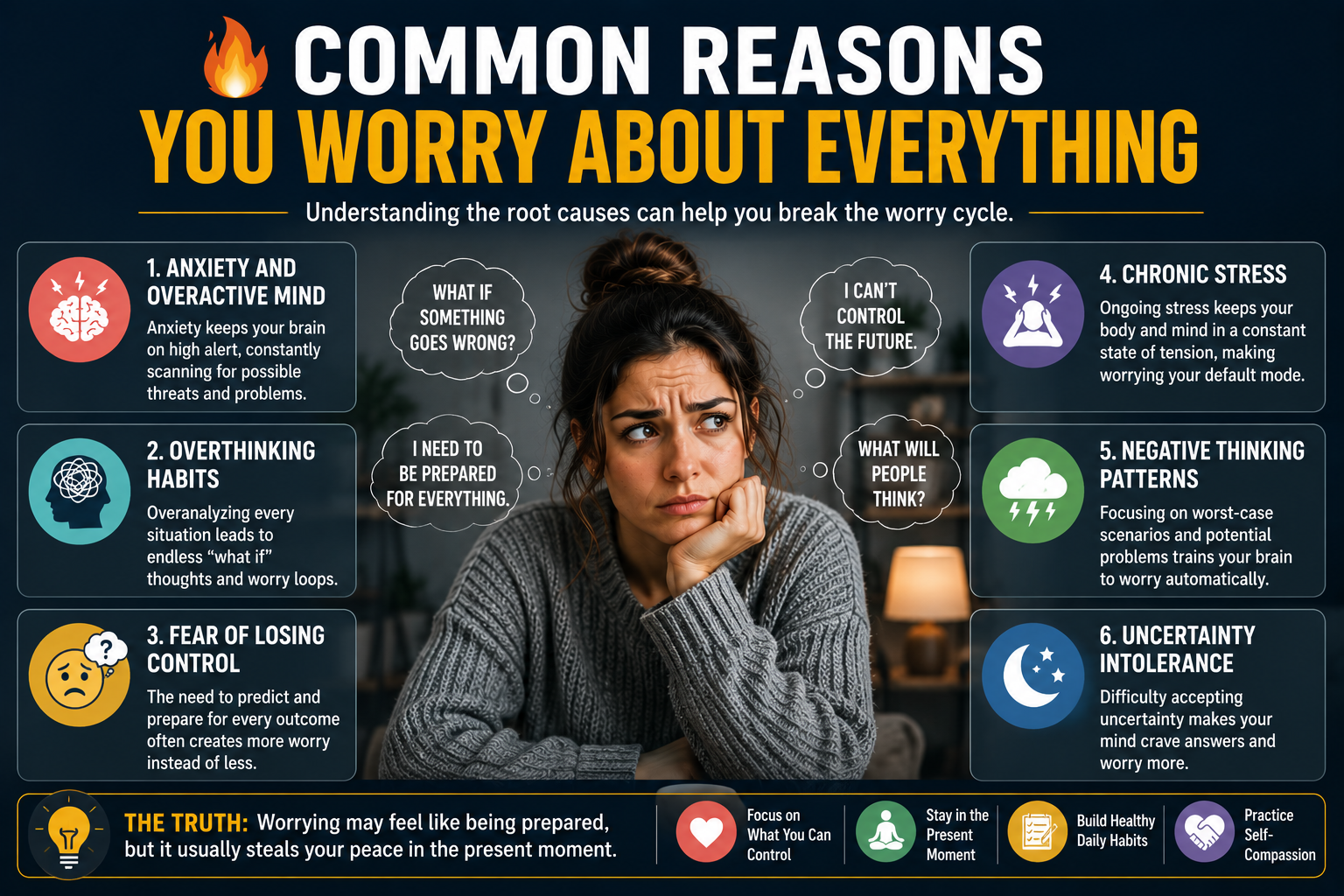
1. Anxiety and Nervous System Overload
When your nervous system stays stressed, your brain becomes more alert to possible danger.
This makes your mind constantly scan for:
- problems
- risks
- mistakes
- worst-case scenarios
Related reading:
2. Overthinking Habits
People who naturally overanalyze situations often struggle to “turn off” mental activity.
Your brain becomes stuck in repetitive loops of:
- what-if thinking
- future fear
- mental replay
Related reading:
3. Fear of Losing Control
Worrying often increases when people feel uncertain about the future.
Your mind may believe:
“If I think about every possibility, I’ll feel more prepared.”
Unfortunately, this usually creates more anxiety instead.
4. Chronic Stress
Long-term stress keeps your body in constant alert mode.
This may cause:
- racing thoughts
- difficulty relaxing
- irritability
- emotional exhaustion
External reference:
https://www.mayoclinic.org
5. Negative Thinking Patterns
Your brain naturally focuses more on potential threats than positive outcomes when stress levels stay high.
This creates automatic worry loops.
🧠 Signs You Are Worrying Too Much
- constant “what if” thoughts
- difficulty relaxing
- racing thoughts
- fear about future situations
- trouble sleeping
- mental exhaustion
- inability to stay present
🧘 How to Stop Worrying About Everything
1. Stop Trying to Predict Every Outcome
Your brain cannot control every future situation.
Trying to mentally solve everything in advance usually increases anxiety.
Instead:
focus on what you can control right now.
2. Interrupt Worry Loops Quickly
When worrying begins:
- change your environment
- move physically
- redirect attention intentionally
The longer worry continues, the stronger the mental loop becomes.
3. Reduce Mental Overload
Too much stimulation increases anxious thinking.
Reduce:
- excessive scrolling
- nonstop news consumption
- multitasking
- constant information intake
4. Calm Your Nervous System Daily
Your brain worries more when your body stays stressed.
Helpful calming habits include:
- deep breathing
- walking
- mindfulness
- stretching
- quiet time away from screens
Related reading:
5. Accept Uncertainty Gradually
Trying to eliminate all uncertainty creates more mental pressure.
Learning to tolerate uncertainty calmly reduces chronic worry over time.
🧠 Why Worrying Gets Worse at Night
Many people experience stronger worrying before sleep because the brain becomes quieter and more internally focused.

This often increases:
- future-focused thinking
- overanalysis
- fear-based thoughts
Related reading:
🧠 When Worrying Becomes Constant
If worrying affects your sleep, focus, emotions, or daily life regularly, your nervous system may be stuck in chronic stress mode.
Structured calming systems can help reduce mental overload and repetitive anxiety patterns.
A guided program like the anxiety relief bundle includes:
- mindfulness exercises
- calming routines
- printable mental reset checklists
- guided stress reduction techniques
🔗 Related Posts – How to Stop Worrying About Everything
- why do I feel anxious for no reason
- how to stop overthinking simple situations
- why my mind won’t stop thinking at night
- why can’t I relax even when nothing is wrong
- mental exhaustion symptoms and recovery
🌿 Conclusion
Constant worrying is usually caused by:
- anxiety
- overthinking habits
- stress overload
- fear of uncertainty
- nervous system exhaustion
The goal is not to control every possible problem, but to calm your nervous system and reduce unnecessary mental pressure.
With consistent calming habits and healthier thinking patterns, chronic worrying can become much easier to manage naturally.


7 Comments
Comments are closed.